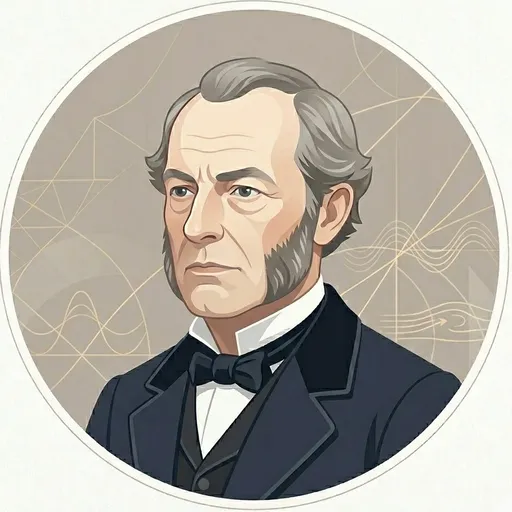
Sir George Gabriel Stokes
1819 - 1903 · Skreen, County Sligo, Ireland (formerly United Kingdom)
A cornerstone of fluid mechanics and mathematical physics, Stokes formulated the governing equations for viscous flow and established the law describing drag on moving particles. In optics, he revolutionized the study of light by discovering and naming fluorescence, detailing how materials emit light of a different wavelength than what they absorb. His namesake theorem in vector calculus remains a vital tool for relating surface integrals to line integrals, forming a mathematical bridge essential to modern electromagnetism.
Life & work
Overview
A cornerstone of fluid mechanics and mathematical physics, Stokes formulated the governing equations for viscous flow and established the law describing drag on moving particles. In optics, he revolutionized the study of light by discovering and naming fluorescence, detailing how materials emit light of a different wavelength than what they absorb. His namesake theorem in vector calculus remains a vital tool for relating surface integrals to line integrals, forming a mathematical bridge essential to modern electromagnetism.
Key milestones
Timeline
Born
Born in Skreen, County Sligo, Ireland (formerly United Kingdom) in 1819.
Senior Wrangler
Stokes graduated from Cambridge University as Senior Wrangler, the top mathematics student of his year.
Navier-Stokes Equations
He published his work on the motion of viscous incompressible fluids, contributing to the formulation of the Navier-Stokes equations.
Lucasian Professor
Stokes was appointed Lucasian Professor of Mathematics at Cambridge University, a position he held for 54 years.
Fluorescence Discovered
He discovered and named the phenomenon of fluorescence, explaining how certain materials absorb light and re-emit it at a different wavelength.
Stokes' Theorem Published
Stokes published his namesake theorem, a fundamental result in vector calculus relating surface integrals to line integrals.
Baronetcy Conferred
He was made a Baronet by Queen Victoria for his distinguished scientific contributions.
Died
Passed away in 1903.
Signature work
Discovery Story
George Gabriel Stokes derived the law in 1851 by solving the Navier-Stokes equations for the specific case of a small, rigid sphere moving slowly through a viscous fluid. This work established the drag force experienced by a sphere in creeping flow, allowing the terminal settling velocity to be calculated by balancing the drag force against the submerged weight (gravity minus buoyancy) of the particle.
While the 1851 derivation assumes a rigid sphere, later refinements like the Hadamard-Rybczynski equation (1911) account for fluid particles (bubbles/droplets), and the Cunningham correction factor accounts for non-continuum effects in gases.
The terminal velocity formula is derived directly from Stokes' original formulation of the drag force on a sphere, F_d = 6πμRv, by balancing it with the net gravitational (buoyant) force.
Key contributions
Achievements
Formulated Stokes's law for the drag on a small sphere moving through a viscous fluid, a key result in fluid mechanics and sedimentation theory.
Made major contributions to the viscous-fluid equations that became known as the Navier-Stokes equations.
Established Stokes's theorem, one of the central results of vector calculus linking surface integrals and line integrals.
Notation used
Symbols & Variables
Geographic context
Birthplace
Skreen, County Sligo, Ireland (formerly United Kingdom)
Citation
Reference
Stokes, G. G. (1851) 'On the Effect of the Internal Friction of Fluids on the Motion of Pendulums', Transactions of the Cambridge Philosophical Society, 9, pp. 8-106.
Common questions
Frequently Asked Questions
A cornerstone of fluid mechanics and mathematical physics, Stokes formulated the governing equations for viscous flow and established the law describing drag on moving particles. In optics, he revolutionized the study of light by discovering and naming fluorescence, detailing how materials emit light of a different wavelength than what they absorb. His namesake theorem in vector calculus remains a vital tool for relating surface integrals to line integrals, forming a mathematical bridge essential to modern electromagnetism.
Sir George Gabriel Stokes lived 1819 - 1903.
Sir George Gabriel Stokes is associated with Physics, Engineering, Mathematics.
Sir George Gabriel Stokes is most strongly associated with the Stokes' Law (Settling Velocity).
The terminal velocity formula is derived directly from Stokes' original formulation of the drag force on a sphere, F_d = 6πμRv, by balancing it with the net gravitational (buoyant) force.
George Gabriel Stokes derived the law in 1851 by solving the Navier-Stokes equations for the specific case of a small, rigid sphere moving slowly through a viscous fluid. This work established the drag force experienced by a sphere in creeping flow, allowing the terminal settling velocity to be calculated by balancing the drag force against the submerged weight (gravity minus buoyancy) of the particle.
Formulated Stokes's law for the drag on a small sphere moving through a viscous fluid, a key result in fluid mechanics and sedimentation theory. Made major contributions to the viscous-fluid equations that became known as the Navier-Stokes equations. Established Stokes's theorem, one of the central results of vector calculus linking surface integrals and line integrals.
Sir George Gabriel Stokes was born in Skreen, County Sligo, Ireland (formerly United Kingdom).
Sir George Gabriel Stokes was associated with country code IE.