René Descartes
1596 - 1650 · La Haye en Touraine (now Descartes), Indre-et-Loire, France
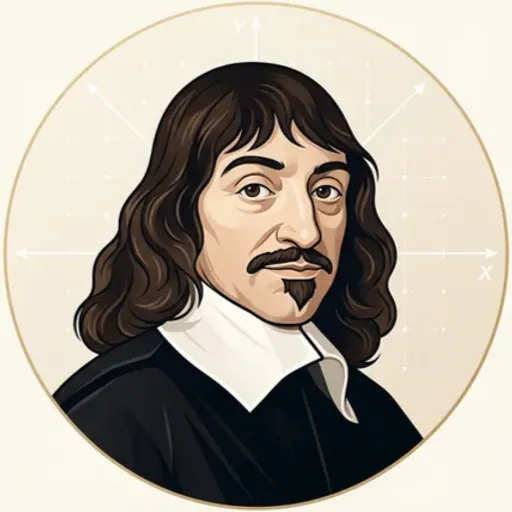
René Descartes was a French philosopher, mathematician, and scientist who is widely regarded as the 'father of modern philosophy.' He is most famous for his philosophical statement 'Cogito, ergo sum' ('I think, therefore I am'), but his impact on mathematics was equally profound. By inventing the Cartesian coordinate system, Descartes bridged the gap between algebra and geometry, establishing the field of analytic geometry. This breakthrough allowed geometric shapes to be represented by algebraic equations, providing a foundational tool for the development of calculus and modern engineering.
Life & work
Overview
René Descartes was a French philosopher, mathematician, and scientist who is widely regarded as the 'father of modern philosophy.' He is most famous for his philosophical statement 'Cogito, ergo sum' ('I think, therefore I am'), but his impact on mathematics was equally profound. By inventing the Cartesian coordinate system, Descartes bridged the gap between algebra and geometry, establishing the field of analytic geometry. This breakthrough allowed geometric shapes to be represented by algebraic equations, providing a foundational tool for the development of calculus and modern engineering.
Key milestones
Timeline
Born
Born in La Haye en Touraine (now Descartes), Indre-et-Loire, France in 1596.
Cartesian Coordinate System
He developed the Cartesian coordinate system, merging algebra and geometry and providing a foundation for calculus.
Laws of Refraction
Descartes formulated the laws of reflection and refraction, advancing the field of optics.
Published 'Discourse on Method'
Descartes published 'Discourse on Method,' which included 'La Géométrie,' introducing analytic geometry.
Published 'Meditations'
He published 'Meditations on First Philosophy,' a foundational text in Western philosophy.
Published 'Principles of Philosophy'
Descartes published 'Principles of Philosophy,' attempting to create a unified system of knowledge based on mechanical principles.
Died
Passed away in 1650.
Signature work
Discovery Story
While Étienne Bézout extensively discussed polynomial properties in his 1764 'Cours de mathématiques', the relationship between roots and linear factors (the Factor Theorem) was known implicitly to earlier mathematicians, including René Descartes. The theorem is a direct corollary of the Polynomial Remainder Theorem, which Bézout formalized.
While the underlying mathematical principle remains unchanged, modern algebraic notation, particularly the use of function notation f(x), provides a more concise and generalized representation compared to earlier symbolic forms.
The equation refers to Bézout's Theorem, which formalizes the number of intersection points of two algebraic curves. René Descartes is associated with the development of the coordinate system that allowed for the formal study of such algebraic geometry, but he is not the discoverer of this specific theorem.
Key contributions
Achievements
Formulated the Factor Theorem in his 1637 work 'La Géométrie,' linking the roots of a polynomial to its linear factors.
Provided the foundational understanding of polynomial division and remainders in the development of analytic geometry.
Developed the Cartesian coordinate system, allowing the geometric circle to be expressed as an algebraic equation.
Formulated the algebraic equation of the parabola within his system of analytic geometry.
Pioneered the analytic geometry that allows distances in 2D space to be calculated using coordinates.
His work in analytic geometry established the concept of slope (gradient) and the relationship between perpendicular lines.
Developed the coordinate system used to prove that parallel lines possess equal gradients.
Established coordinate geometry, the foundation upon which vector equations are built.
Independently derived and first to publish the law using sines.
Founded analytic geometry, which allows for the representation of lines through algebraic equations like the slope-intercept form.
Introduced the Cartesian coordinate system, which is essential for defining the point-slope form of a linear equation.
Introduced the modern notation for exponents which is essential for standard form.
Developed the Cartesian coordinate system, allowing the application of Pythagoras' theorem to coordinates.
Established the modern algebraic notation for powers and multiplication of indices.
Refined exponent laws into the standard symbolic forms used in division and subtraction of indices.
Formalized the power of a power rule using his system of algebraic notation.
Proposed an early version of the conservation of momentum, though he used speed instead of velocity.
Independently derived the law of refraction and applied it to the study of rainbows and internal reflection.
An early proponent of the idea that the total 'quantity of motion' in the universe remains constant.
Notation used
Symbols & Variables
Geographic context
Birthplace
La Haye en Touraine (now Descartes), Indre-et-Loire, France
Citation
Reference
Descartes, R. (1637) La Géométrie. Leiden: Jan Maire.
Common questions
Frequently Asked Questions
René Descartes was a French philosopher, mathematician, and scientist who is widely regarded as the 'father of modern philosophy.' He is most famous for his philosophical statement 'Cogito, ergo sum' ('I think, therefore I am'), but his impact on mathematics was equally profound. By inventing the Cartesian coordinate system, Descartes bridged the gap between algebra and geometry, establishing the field of analytic geometry. This breakthrough allowed geometric shapes to be represented by algebraic equations, providing a foundational tool for the development of calculus and modern engineering.
René Descartes lived 1596 - 1650.
René Descartes is associated with Mathematics, Physics.
René Descartes is most strongly associated with the Factor Theorem.
The equation refers to Bézout's Theorem, which formalizes the number of intersection points of two algebraic curves. René Descartes is associated with the development of the coordinate system that allowed for the formal study of such algebraic geometry, but he is not the discoverer of this specific theorem.
While Étienne Bézout extensively discussed polynomial properties in his 1764 'Cours de mathématiques', the relationship between roots and linear factors (the Factor Theorem) was known implicitly to earlier mathematicians, including René Descartes. The theorem is a direct corollary of the Polynomial Remainder Theorem, which Bézout formalized.
Formulated the Factor Theorem in his 1637 work 'La Géométrie,' linking the roots of a polynomial to its linear factors. Provided the foundational understanding of polynomial division and remainders in the development of analytic geometry. Developed the Cartesian coordinate system, allowing the geometric circle to be expressed as an algebraic equation. Formulated the algebraic equation of the parabola within his system of analytic geometry. Pioneered the analytic geometry that allows distances in 2D space to be calculated using coordinates. His work in analytic geometry established the concept of slope (gradient) and the relationship between perpendicular lines. Developed the coordinate system used to prove that parallel lines possess equal gradients. Established coordinate geometry, the foundation upon which vector equations are built. Independently derived and first to publish the law using sines. Founded analytic geometry, which allows for the representation of lines through algebraic equations like the slope-intercept form. Introduced the Cartesian coordinate system, which is essential for defining the point-slope form of a linear equation. Introduced the modern notation for exponents which is essential for standard form. Developed the Cartesian coordinate system, allowing the application of Pythagoras' theorem to coordinates. Established the modern algebraic notation for powers and multiplication of indices. Refined exponent laws into the standard symbolic forms used in division and subtraction of indices. Formalized the power of a power rule using his system of algebraic notation. Proposed an early version of the conservation of momentum, though he used speed instead of velocity. Independently derived the law of refraction and applied it to the study of rainbows and internal reflection. An early proponent of the idea that the total 'quantity of motion' in the universe remains constant.
René Descartes was born in La Haye en Touraine (now Descartes), Indre-et-Loire, France.
René Descartes was associated with country code FR.