Vilfredo Pareto
1848 - 1923 · Paris, Île-de-France, France
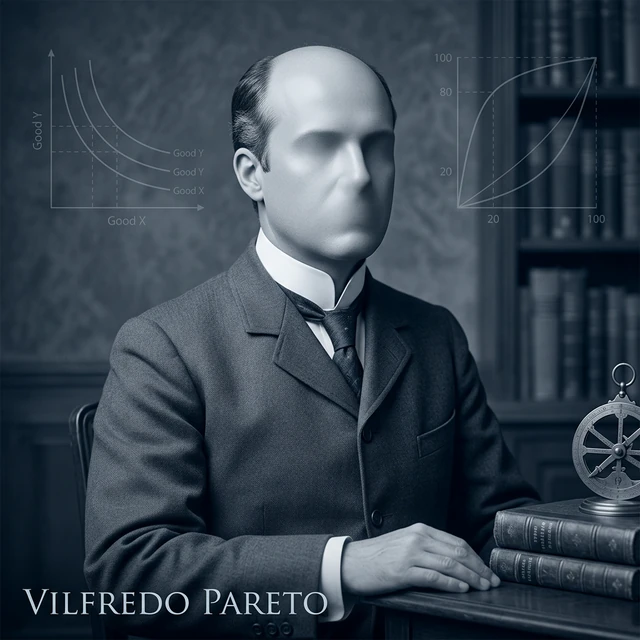
Pareto transformed economic theory by introducing indifference curves, shifting the field from cardinal utility to a framework based on ordinal preferences. He is best known for developing the concept of Pareto efficiency, which remains a cornerstone of welfare economics and resource allocation. His mathematical analysis of wealth distribution also laid the groundwork for modern power-law statistics and the study of social equilibrium.
Life & work
Overview
Pareto transformed economic theory by introducing indifference curves, shifting the field from cardinal utility to a framework based on ordinal preferences. He is best known for developing the concept of Pareto efficiency, which remains a cornerstone of welfare economics and resource allocation. His mathematical analysis of wealth distribution also laid the groundwork for modern power-law statistics and the study of social equilibrium.
Key milestones
Timeline
Born
Born in Paris, Île-de-France, France in 1848.
Pareto Distribution
Published his observations on income distribution, leading to the concept of the Pareto distribution.
Indifference Curves
Introduced indifference curves, shifting economic theory from cardinal utility to ordinal preferences.
Pareto Efficiency
Developed the concept of Pareto efficiency, a cornerstone of welfare economics and resource allocation.
Treatise on General Sociology
Published his comprehensive work on sociology, applying mathematical and logical methods to social phenomena.
Died
Passed away in 1923.
Signature work
Discovery Story
Italian statistician Corrado Gini developed the coefficient in 1912 as a measure of statistical dispersion to quantify income and wealth inequality. His work, published in 'Variabilità e mutabilità', aimed to provide a single numerical value representing the degree of concentration within a distribution, significantly advancing the field of descriptive statistics beyond the graphical methods available at the time.
The coefficient was originally defined by Gini as the 'mean difference' of a distribution. Its modern geometric interpretation using the Lorenz curve became the standard pedagogical approach in economics decades later, facilitating its use in comparing national income distributions.
While the Gini coefficient was introduced by Corrado Gini, the specific formula Gini = A / (A + B) is a geometric interpretation derived from the Lorenz curve, which was developed independently by Max O. Lorenz in 1905.
Key contributions
Achievements
Introduced indifference curves, the foundation for the marginal rate of substitution.
Notation used
Symbols & Variables
Geographic context
Birthplace
Paris, Île-de-France, France
Citation
Reference
Pareto, V. (1906) Manuale di economia politica. Milan: Società Editrice Libraria.
Common questions
Frequently Asked Questions
Pareto transformed economic theory by introducing indifference curves, shifting the field from cardinal utility to a framework based on ordinal preferences. He is best known for developing the concept of Pareto efficiency, which remains a cornerstone of welfare economics and resource allocation. His mathematical analysis of wealth distribution also laid the groundwork for modern power-law statistics and the study of social equilibrium.
Vilfredo Pareto lived 1848 - 1923.
Vilfredo Pareto is associated with Economics.
Vilfredo Pareto is most strongly associated with the Gini Coefficient.
While the Gini coefficient was introduced by Corrado Gini, the specific formula Gini = A / (A + B) is a geometric interpretation derived from the Lorenz curve, which was developed independently by Max O. Lorenz in 1905.
Italian statistician Corrado Gini developed the coefficient in 1912 as a measure of statistical dispersion to quantify income and wealth inequality. His work, published in 'Variabilità e mutabilità', aimed to provide a single numerical value representing the degree of concentration within a distribution, significantly advancing the field of descriptive statistics beyond the graphical methods available at the time.
Introduced indifference curves, the foundation for the marginal rate of substitution.
Vilfredo Pareto was born in Paris, Île-de-France, France.
Vilfredo Pareto was associated with country code FR.